Request a signature without DocuSign
Almost nobody who types "docusign alternatives free" into a search box wants a platform. They have one document, one counterparty, and an afternoon. What the results serve up is a wall of "top 10 free e-sign tools" listicles, most of them affiliate pages for the same subscription product wearing a different logo. The honest answer is less clickable: whether you can skip DocuSign depends on what the signature needs to accomplish, and that question has exactly three answers. Two of them are free. Knowing which one you need is the whole decision.
What the subscription actually pays for
A signature itself has been free since 2000, when the US ESIGN Act defined it as "an electronic sound, symbol, or process, attached to or logically associated with a contract or other record and executed or adopted by a person with the intent to sign" (15 U.S.C. §7006). A typed name clears that bar. So does a scribble drawn with a mouse. No vendor's cryptography is what makes a document binding, and the serious platforms do not claim otherwise; the law attaches to the act of signing, not to the brand on the completion email.
What the subscription pays for is the evidence that the act happened: email or SMS checks that the signer is who they claim to be, an audit trail of every view and click, and a tamper-evident certificate of completion. Those are real products solving a real problem. They are also beside the point unless someone might one day dispute who signed, when they signed, or what they saw before they did.
Here is the pricing reality, because "free trial" pages bury it. DocuSign's official pricing (checked October 2026) lists Personal at $11/month for individuals, Standard at $30 per user per month, and Business Pro at $45 per user per month, all on annual commitments. Personal includes five envelopes a month, and an envelope counts as used the moment you send it, signed or not. Independent breakdowns (VerD's pricing analysis) put month-to-month billing meaningfully higher, and the per-envelope math works out to about $2.20 per envelope even on the cheapest tier. Prices move; the structure is the story. You are buying an evidence chain by the month.
Which is the observation this article exists to make: platforms charge for the evidence chain, not the signature, and for a large share of signature jobs the parties themselves are the evidence chain. A landlord who has exchanged forty emails with a tenant, handed them keys, and deposited their rent every month since will never need an audit trail to establish that the tenant agreed to the lease. The relationship already is the audit trail.
Decide what you need before you pick a tool
The three needs, in ascending order of cost:
A visible sign-off. Someone needs to record intent and approval on the page. Drawn, typed, or uploaded signature; free in any competent editor. It proves somebody meant to sign. It cannot detect later edits, ever.
Tamper-evidence between parties who know each other. You want the file itself to reveal whether a number changed after signing. That is a certificate signature, a cryptographic operation over the file's actual bytes; free, local, and verifiable in any compliant viewer years later. It does not prove the signer's legal identity, only that the holder of that key signed this exact file. Between parties who already know each other, that is precisely the missing piece and nothing more.
Verified identity plus a documented process. Strangers, high stakes, auditors, disputes waiting to happen. Someone uninvolved must later be able to vouch that each signer was verified and that the process ran as described. That is a platform. It costs money, and in exactly these cases it is worth the money.
If the mechanics of the first two routes are what you need, how to sign a PDF walks through them step by step, and the terminology tangle behind "electronic" versus "digital" is untangled in electronic vs digital signatures.
Four documents, four different answers
The abstract version above becomes obvious with real documents.
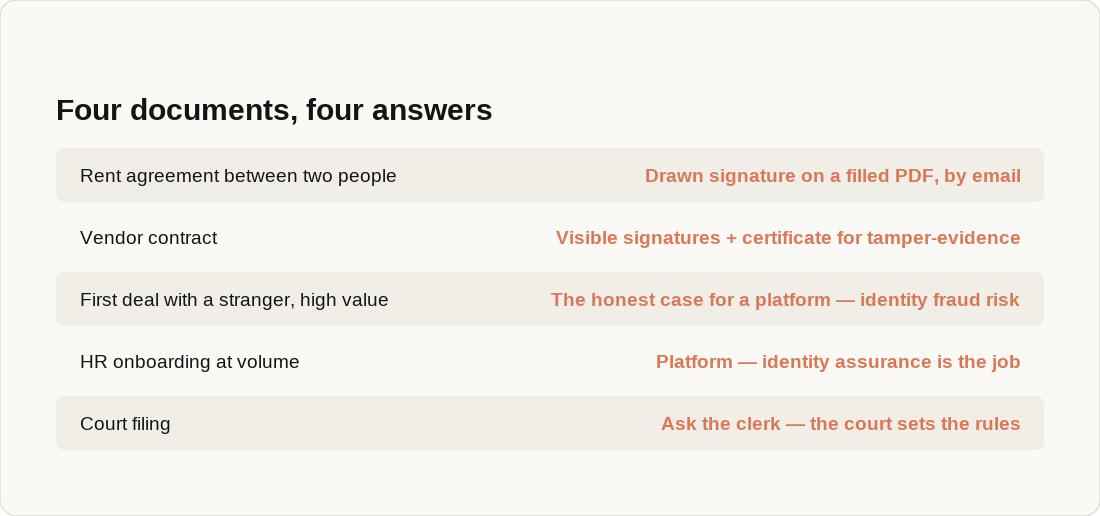
A rent agreement between two people. The parties have met. They exchanged emails, toured the apartment, and transfer money monthly. A drawn signature on a filled PDF, emailed back and forth, is proportionate and then some; a certificate signature on the final file adds free tamper-evidence if you want it. Paying a subscription here automates a process that takes four minutes by email, and the parties' own records already prove everything a certificate of completion would.
A vendor contract. Real money, months of performance, and a dispute that might surface years later when memories have faded. The free route still works: visible signatures for the humans, a certificate signature on top so the bytes can testify. The exception is the first deal with an entity nobody at your company has met, at a value where identity fraud is a plausible business model. There, one month of platform fees is cheaper than one dispute, and that is the honest case for paying.
HR onboarding. A company signs people it has never met, at volume, and creates records that auditors or regulators may inspect years later. Identity assurance is the point, not a nicety, and volume turns the envelope math into a predictable cost of doing business. This is the job platforms were built for, and free tools are the wrong answer here, not because the signatures would be invalid but because nobody verified the signer.
A court filing. The receiving party sets the rules, full stop. Court filings are among the usual suspects for electronic-signature carve-outs, and many courts want wet ink or their own e-filing system regardless. Neither a free tool nor a subscription automatically qualifies. Ask the clerk before spending money or confidence; buying a platform for a filing the court will reject is the mirror-image mistake of scrawling a drawn signature on a stranger-deal.
The DIY evidence chain, done properly
Between known parties, you can build a legitimate evidence chain yourself, and it is not a hack. It is how business ran for a century, with better timestamps.
- Send the final PDF as an attachment from a real, identifiable address, and keep the sent copy. The headers timestamp the exchange.
- Each party signs: the visible mark for humans, a certificate signature on top for the bytes. Sign last; any later edit invalidates the certificate, which is the feature.
- Return the exact signed file as an attachment. Not a link, not a print-and-rescan. The bytes are the evidence; preserve them untouched.
- Optionally, paste both files' SHA-256 checksums into the thread, so a byte-level comparison is possible in 2036 without arguing about which copy is canonical.
What this chain proves: who sent what, when, and that the file never changed after signing. What it cannot do: verify a stranger. A compromised inbox is indistinguishable from its owner at this layer, and that gap is precisely the product a platform sells. If identity is the question, no pile of saved originals answers it. Note also what a self-signed certificate asserts and does not: self-signed certificate signing covers that honestly.
If the document is a form rather than a letter, filling it is its own workflow with its own traps: filling and signing PDF forms.
Where LivePDF fits
LivePDF does the two free routes, locally, and nothing else, which is the honest scope. Drawn, typed, and uploaded signatures, plus real certificate signing with a .pfx/.p12 digital ID or a self-signed one, all in the browser with the file never leaving the device. It does not verify anyone's identity, keep an audit trail, or send signature requests to anyone; it is an editor, not a service. If your job falls under the first two needs above, that is everything you require and nothing you are renting.
The one-paragraph version
Platforms sell the evidence chain; the signature itself has been free since ESIGN. When the parties know each other, the parties are the evidence chain: sign visibly, add a certificate signature, keep the originals, skip the subscription. When a stranger's identity or an auditor's questions are in play, buy the platform, because verification is work you cannot do yourself. And when the receiving party sets the rules, a court, a registry, a university, ask them first. Neither route overrides a clerk with requirements.
Sources and further reading
- DocuSign plans and pricing (official)
- VerD: DocuSign pricing breakdown
- SignSend: cost per envelope on DocuSign Personal
- ESIGN Act, 15 U.S.C. §7006 (GovInfo)
Word count: 1410
FAQ
Is a free DocuSign alternative legally valid?
For ordinary documents between parties who accept the method, usually yes. The US ESIGN Act defines an electronic signature as any electronic sound, symbol, or process attached to a record with the intent to sign; it does not require a paid platform or any cryptography. What a platform adds is evidence (identity verification, audit trail), not validity. Some document types follow jurisdiction-specific rules, so check those before relying on any method, paid or free.
How many documents can I send on DocuSign's cheapest plan?
The Personal plan includes five envelopes per month, and an envelope counts as used the moment you send it, whether or not anyone signs. At $11/month on an annual commitment (as of October 2026), that works out to roughly $2.20 per envelope, and month-to-month billing costs more. Prices change; check the plan page before deciding.
Can I build an audit trail myself without a platform?
For documents between parties who know each other, yes. An email trail with timestamps, a certificate signature on the PDF, and the untouched original files form a legitimate evidence chain. What you cannot DIY is identity verification of a stranger; a compromised inbox looks identical to its owner, and closing that gap is what platforms genuinely sell.