Electronic vs digital signatures: what each one proves
"Electronic signature vs digital signature" is the terminology tangle behind a lot of confused signing advice. The two phrases get used as if they're synonyms, and the gap between them causes real arguments. One is a legal category that accepts almost any electronic mark of agreement. The other is a specific cryptographic technique. Sort them out once and the whole subject gets clearer.
The difference in one sentence
Every digital signature is an electronic signature. Most electronic signatures are not digital signatures.
"Electronic" is the umbrella. "Digital" is one technical branch underneath it. That single relationship explains almost every disagreement about signing documents.
What each term actually means
Electronic signature (legal). The US ESIGN Act, 15 U.S.C. §7006, defines it as "an electronic sound, symbol, or process, attached to or logically associated with a contract or other record and executed or adopted by a person with the intent to sign the record." Read that literally: a typed name in an email, a click on "I agree", a signature drawn with a finger, or a scan of an ink signature all fit. No cryptography required.
Digital signature (cryptographic). NIST's glossary calls it "the result of a cryptographic transformation of data that, when properly implemented, provides a mechanism for verifying origin authentication, data integrity, and signatory non-repudiation." In practice it's produced by a private key stored in something like a .pfx or .p12 file, and checked against the matching certificate.
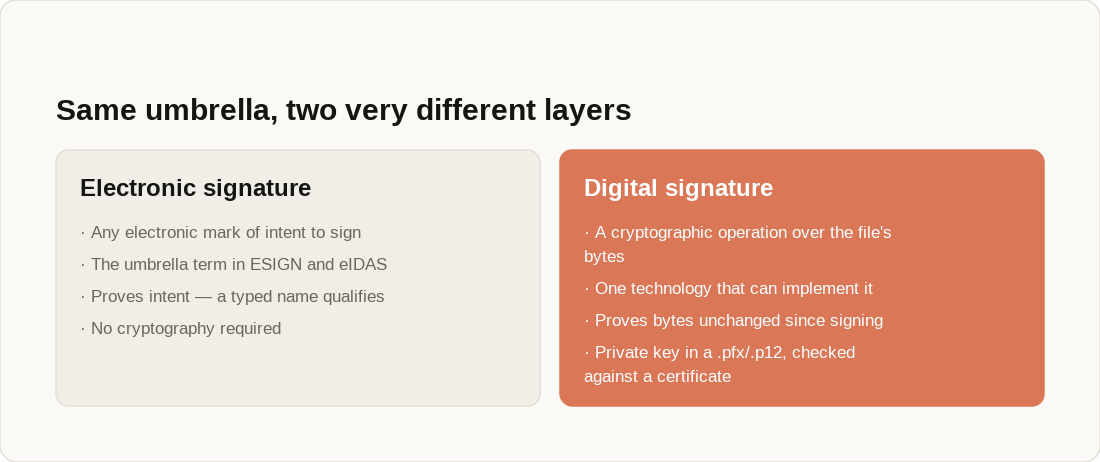
The two are easy to line up side by side.
| Electronic signature | Digital signature | |
|---|---|---|
| What it is | Any electronic mark of intent to sign | A cryptographic operation over the file's bytes |
| Legal layer | The umbrella term in ESIGN and eIDAS | One technology that can implement it |
| What it proves | Intent to sign | Bytes unchanged since signing, plus who holds the key |
| Identity | Only what the surrounding process establishes | Only as strong as the certificate's issuer |
| Tamper detection | None | Yes, by design |
| Example | Typed name, drawn or scanned signature, "I agree" button | .pfx/.p12 certificate signature, qualified eIDAS signature |
What the law actually asks for
The EU's eIDAS regulation, Regulation 910/2014, layers three named levels:
- Simple electronic signature (Art. 3(10)): data in electronic form attached to or logically associated with other data, used by the signatory to sign.
- Advanced electronic signature (Art. 3(11)): uniquely linked to the signatory, capable of identifying them, created using data under their sole control, and linked to the signed data so later changes are detectable.
- Qualified electronic signature: advanced, plus a qualified signature-creation device and a qualified certificate. Art. 25(2) states that a qualified electronic signature "shall have the equivalent legal effect of a handwritten signature."
Only the qualified level carries that EU-wide handwriting equivalence. But the simple level is still legally meaningful, which is the part people skip. Under ESIGN in the US, §7001 says a signature can't be denied effect just because it's electronic, and the statute is deliberately technology-neutral. It never mentions cryptography.
So the floor for a meaningful electronic signature is intent plus evidence that can be attributed to a person. Not mathematics.
A Venn, sort of
Picture a large circle labeled "electronic signature." Everything simple under eIDAS and ESIGN lives here. Inside it sits a smaller circle, "advanced electronic signature." Inside that, "qualified." Cryptographic digital signatures live in the advanced circle.
The confusion runs in both directions. "E-signature" gets used to mean "a picture of my signature," which is only one kind of simple e-signature, not the definition. And "digital signature" gets used for any signature made on a computer, which is far too broad. A vendor's brand name is neither of those things; a mainstream e-sign service usually provides simple or advanced signatures unless a qualified certificate is in play.
The myth: the pixel proves identity
The most stubborn misconception is that a more realistic-looking signature is a stronger one. It isn't. A pixel-perfect scan of your handwriting is still a simple electronic signature with no tamper detection. Change a digit in the total and nothing fails verification. Conversely, a digital signature isn't automatically proof of who you are: anyone can create a self-signed certificate bearing any name. The key proves a key was used, not that a particular person used it. That gap is why we wrote a separate piece on what a self-signed certificate does and doesn't prove.
The process is the proof
The law weighs the process, not the pixels. The law doesn't care about the pixels or the cryptography. It cares about the process around the signature, meaning whether someone can later attest to what happened.
eIDAS says it directly: an advanced signature must be "capable of identifying the signatory." ESIGN says it through "intent to sign." Both are questions about human acts and records, not algorithms.
That is why plain scanned ink signatures hold up in practice. A paper contract that gets signed, scanned, and emailed is an electronic signature at the simple level. It proves nothing cryptographically, yet it is routinely accepted, because the paper trail does the work: a witness, a notary, an email thread, a counterparty who admits they signed. The signature is weak; the paper trail is what carries it.
Flip it around and you get the other surprise. A cryptographically flawless signature can still be legally hollow if nothing ties the key to a person. Integrity and identity are separate questions, and a verification check can only answer the first one on its own.
Which one should you use?
A short decision path:
- You're signing an ordinary agreement, an internal approval, or a consent form, and the other side just needs a visible, intended mark: a simple electronic signature is usually enough. See how to sign a PDF for the mechanics.
- You need the file itself to reveal edits made after signing: add a digital signature. It is the only route that detects tampering.
- You need to prove who signed to a stranger who doesn't know you: the certificate has to come from a trusted issuer, or from a service that verifies identity. A self-signed certificate won't do it.
- You need the EU-level equivalence to a handwritten signature: a qualified electronic signature through a trust service provider.
For forms specifically, the signature is only half the job; the field has to accept it, which is its own topic in filling and signing PDF forms.
Where a free tool fits
LivePDF can place a drawn or typed signature on a page, and it can apply a proper cryptographic digital signature using a .pfx/.p12 file or a self-signed ID, with a validation panel that reports whether the bytes changed since signing. What it is not: an identity-verifying e-sign service. There's no DocuSign-style identity check, no qualified certificate, no third-party audit trail. For "did this file change, and does someone hold this key," it works. For "prove to a court that this specific person signed," lean on the process instead: a platform with identity checks, a notary, or whatever your jurisdiction requires.
The takeaway
Electronic signature is the legal umbrella; digital signature is one cryptographic tool inside it. Use the simple kind when intent is all you need to show, and the digital kind when the file must prove it hasn't changed. Either way, remember what the law is actually weighing: not your signature's pixels, but the process that lets someone vouch for it later.
Sources and further reading
- NIST CSRC glossary: digital signature
- NIST FIPS 186-5: Digital Signature Standard
- eIDAS, Regulation (EU) 910/2014 (EUR-Lex)
- ESIGN Act, 15 U.S.C. §7006 (GovInfo)
Word count: 1305
FAQ
Is an electronic signature legally binding?
It depends on the document and the jurisdiction, not the technology. In the US, ESIGN (15 U.S.C. §7001) says a signature can't be denied effect just because it's electronic, and the EU's eIDAS gives qualified electronic signatures the equivalent effect of a handwritten one. Some document types are carved out and need jurisdiction-specific rules.
What is the difference between an electronic signature and a digital signature?
An electronic signature is the legal umbrella: any electronic indication of intent to sign, including a typed name, a drawn mark, or a scanned signature. A digital signature is a cryptographic technique that additionally proves the file hasn't changed and which key signed it. Every digital signature is an electronic signature; most electronic signatures aren't digital.
Do I need a digital signature for a contract to be valid?
Not usually. Many contracts are validly signed with a simple electronic signature, because the law asks for intent and attribution, not cryptography. A digital signature matters when you also need to show the file wasn't altered after signing, or when the signer's identity has to be verified by a certificate.