Blog › Privacy & local processing
Who invented the PDF? A format that won by standing still
The PDF was invented by John Warnock, co-founder of Adobe, in 1991. That one sentence is true and almost useless, because the interesting part is not who but why. The format exists because Warnock was tired of watching beautiful documents fall apart the moment they left the machine that made them.
The problem in 1991
Every document had this problem. A memo written in WordPerfect arrived in Word with the margins shifted. A report designed on a Mac reached a DOS machine with the fonts replaced by something slab-sided and wrong. Printing it fixed the layout and lost the colors. The document was not a thing; it was a set of instructions that only one program knew how to interpret.
Warnock's answer was a memo, circulated internally at Adobe in 1991, titled The Camelot Project. Its pitch was almost arrogant in its simplicity: a system for capturing documents from any application, sending the electronic version to anywhere, and displaying and printing it exactly as the author intended. The key word is any. Not "on machines that bought the right software." Not "if both offices standardize." Any.
From Camelot to PDF
The memo described what became the Interchange PostScript variant, then PDF, and it shipped in 1993 inside Acrobat 1.0, alongside a printer-driver approach that let any application "print" straight into the format. People complained that Acrobat cost money and the Reader was a download; the format spread anyway, because once a document left as a PDF, the argument about fonts was over.
The capture mechanism was the clever part. Instead of asking every software company to support a new format, Camelot rode the print path every application already had: if a program could print, it could produce a PDF. A format that arrives through the printer driver does not need adoption; it needs a printer dialog. That one decision spread PDF through every office on earth without a single marketing campaign for the format itself.
Acrobat 1.0 shipped in 1993 with two halves: the paid tools that made PDFs and the free Reader that opened them. Free readers were not the norm yet, and distribution was physical - PDFs traveled on CD-ROMs bundled with magazines before the web made them trivial to pass around. Once the web arrived, the format stopped needing help at all. A document format built for machine-to-machine transfer found its perfect distribution network, and the rest is attachment culture.
If you want to understand why PDFs behave the way they do today, the answer is in that origin. PDF is PostScript's document-shaped cousin: a page-description language, built for printers, carrying the "this is finished" assumption of paper into a digital world. That inheritance is why editing a PDF is nothing like editing a Word file, and why the whole subject deserves its own explanation.
The ISO handoff
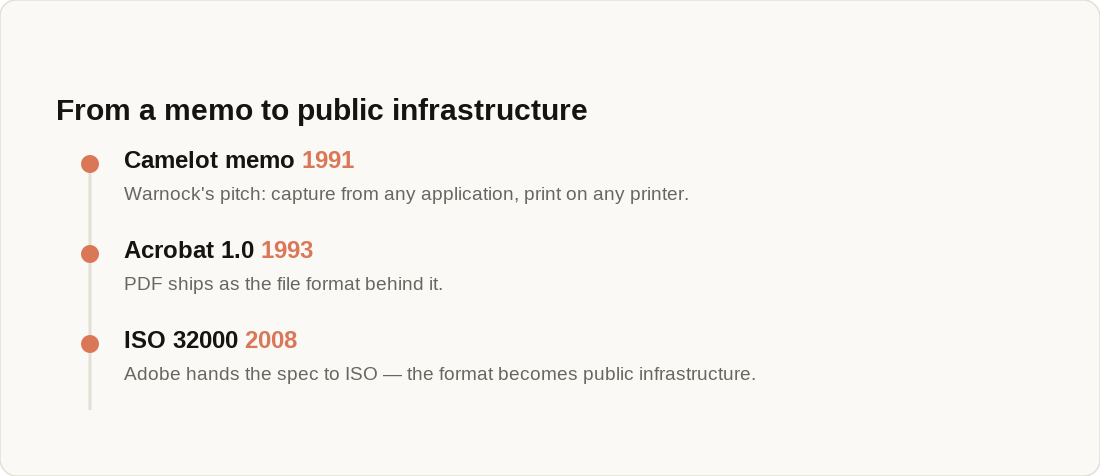
For fifteen years PDF was Adobe's proprietary specification, published openly but controlled by one company. That worked until PDF became infrastructure - the format governments and courts started requiring - and infrastructure controlled by a single vendor makes archivists nervous. In 2008, Adobe handed the specification to the International Organization for Standardization. PDF became ISO 32000, and its evolution passed to a committee.
The company kept selling the tools. The format became a public utility. This is a rarer outcome than it should be, and it is the reason a 2008-era file and a 2026-era file open in the same reader without ceremony. The version line on the first bytes of a PDF is a floor, not a fashion; the details are in PDF versions explained.
The quiet success
PDF's competitors promised more. OpenDocument promised editability. Various XML formats promised structure. Web formats promised freshness. All of them changed, some of them constantly, and every change was a chance for a fifteen-year-old document to stop rendering correctly.
PDF promised almost nothing: the pages will look like this, forever, on anything. It kept the promise. That is the whole trick. A format designed by a printer company to do a printer's job - freeze the ink, ship the pages - turned out to be exactly what a networked world needed, because a networked world is full of machines that disagree.
The same conservatism is why PDF/A exists as an archiving standard, with its rules about embedded fonts and forbidden JavaScript: PDF/A is a discipline of removing everything that depends on the outside world, and PDF was already halfway there at birth.
The one-line version
John Warnock invented the PDF in 1991 to stop documents from changing, and the format has been faithfully refusing to change ever since. Every frustration you have had editing one, and every relief you have had opening one unchanged, is the same design decision wearing two moods.
Sources and further reading
- The Camelot Project memo (1991), via the PDF Association
- ISO 32000-2:2020, the current PDF standard
- ISO 32000-1:2008 free copy hosted by Adobe
FAQ
Who invented the PDF?
John Warnock, co-founder of Adobe, conceived the format in his 1991 internal memo 'The Camelot Project.' It was refined by Adobe engineers and shipped in 1993 as part of Acrobat 1.0. Adobe handed the specification to the International Organization for Standardization in 2008, making it ISO 32000.
What was the Camelot Project?
The 1991 internal memo by John Warnock that became PDF. It described capturing documents from any application, displaying them on any machine, and printing them on any printer - the three promises PDF still keeps. The original memo is available through the PDF Association.
Why did Adobe give PDF to ISO?
After fifteen years, PDF was everywhere and governments increasingly required it. Open standardization removed the last reason to distrust a single-vendor format, and it locked in the stability that made long-term archiving practical. Adobe kept making money from Acrobat tools; the format itself became public infrastructure.